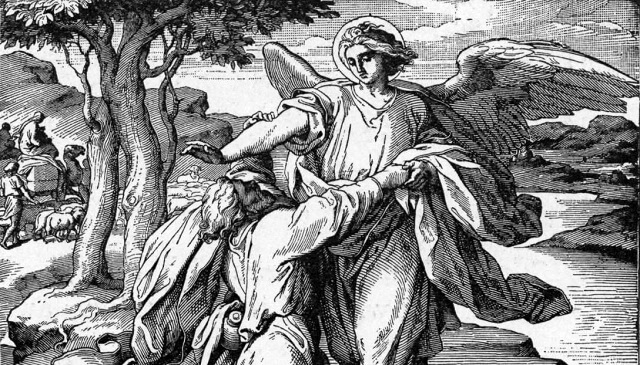
Twice, Jacob was informed that his name was now “Israel”: first by the angel who wrestled with him at Peniel, and later by God Himself.
Your name will no longer be said to be Jacob, but Israel. You have struggled before God and man, and you have overcome (Gen. 32:29).
Why was it necessary to change Jacob’s name? What is the significance of the names “Jacob” and “Israel”?
More puzzling is the fact the change was not irrevocable. Once Abram became Abraham, his former name was never again used. But even though Jacob’s name was changed to Israel, he still retained his former name. Why?
The Dangers of Nationalism
It is commonly accepted that countries have the right to expand their influence and possessions, even at the expense of neighboring countries. Many enlightened rulers have spilled much blood to advance their empires and national wealth, without concern for other peoples. Human morality has progressed enough to admit that one should not seek to gain at the expense of others — but this is usually restricted to the realm of the individual.
Even those who do not advocate war and conquest are nonetheless concerned almost exclusively with the prosperity and well-being of their own country. The fact that all people are created in God’s image is conveniently ignored.
One might think that the Torah also condones this outlook. After all, were not the Israelites commanded to conquer the Land of Israel and defeat the Canaanites? But if we wish to be intellectually honest, this is untenable. Why should God, Whose mercy extends to all creatures, seek to harm His own creations?
In truth, all are equal before God, and the ultimate goal is the complete happiness of all creatures. However, the perfection of humanity requires the unique contribution of a special people who enlighten and educate the world. Such a nation needs to remain separate in order to accomplish its task, much like the mind which is separate from the body.
Thus, the Torah only permits warfare when it will advance the world’s betterment. Before waging an elective war (not in self-defense or in order to conquer the Land of Israel), the king must obtain the approval of the Sanhedrin and the prophetic Urim and Thumim worn by the High Priest. This consultation confirms that the proposed action is in accordance with God’s Will.
Abraham’s Universalism
Abraham’s original name, “Abram,” means “father of Aram.” Since Abraham needed to widen his horizons and look beyond the welfare of his own people, he was renamed “Abraham” — “the father of many nations.” This new name indicated that Abraham should work towards the betterment of all peoples. In fact, it was forbidden to use his former name. Doing so would imply that God’s unique relationship with Abraham stemmed from some special concern for the nation of Aram.
While Abraham belonged to all humanity, he was also the beginning of a separate, distinct people. His son Isaac similarly combined these two qualities: universal concern for all nations, and separation to safeguard his special holiness for future generations.
In Isaac’s twin sons, however, these traits were separated. Esau was a “man of the field,” an outgoing personality who integrated with the rest of the world. Jacob, on the other hand, was a scholar who kept to himself. He was “a quiet man, dwelling in tents” of Torah study.
Jacob’s Special Identity
The name Jacob (Ya’akov) refers to his grasping Esau’s heel (eikev) when they were born. From the very start, Jacob tried to hold back Esau’s drive to integrate and assimilate. To maintain his special identity, Jacob held Esau back with his hand. The hand is a metaphor for the practical (“hands-on”) aspect of mitzvot which distinguish and separate the Jewish people from other nations.
As long as the world has not sufficiently advanced, and the true purpose of the mitzvot is concealed, Jacob will retain his original name. The mitzvot enable him to inhibit the Esau-tendencies towards assimilating into the rest of humanity.
In the future, the Torah’s light will radiate over Jacob. Esau will recognize that his approach of assimilation before its time led him to be lost and corrupted.[1]
And Jacob will no longer need to “hold back Esau’s heel.” The primary function of mitzvot will no longer be to prevent assimilation among the nations. When the triumphant splendor of greatness will shine on Israel, and the nations will be drawn to follow the light of his Torah, how could he lower himself from his elevated stature? Jacob will be recognized as Yisrael — “he will lead” (from the Hebrew word sar, meaning “leader”). All will recognize that it is suitable for Israel to remain apart, just as a leader must maintain distance in order to lead and instruct.
But even then, the name Jacob will not be discarded. Even in the Messianic Era, the mitzvot will still serve to “hold back Esau’s heel.”
Many nations will go, saying, let us rise up to the mountain of God, to the house of Jacob’s God (Isaiah 2:3).
(Adapted from Midbar Shur, pp. 200-209)
Illustration image: Jacob Wrestled with an Angel, Foster (1897)
Here, Esau is a metaphor for Christianity. In his work Orot, Rav Kook criticizes Christianity as an offshoot of Judaism which made the critical mistake of assuming that Israel’s spiritual potential was already fully realized and the time was ripe to convert all of humanity. ↩︎