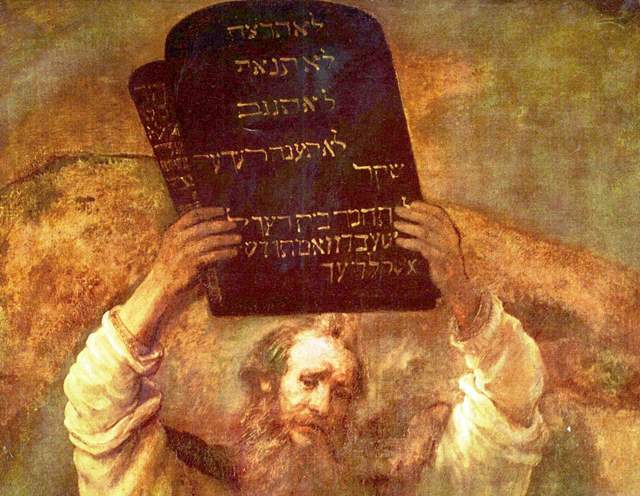
The Luchot — the stone tablets that Moses carried down from Mount Sinai — were extraordinary. The Torah describes them as "made by God” and "written with God’s script” (Exod. 32:16).
What was so remarkable about the writing on the Luchot?
The letters were engraved on both sides of the stone. According to the Talmud, the engraving pierced the tablets completely, from one side to the other (Shabbat 104a).
This tradition is especially amazing when taking into account that two Hebrew letters — the final Mem (ם) and the Samekh (ס) — have the topological shape of a donut. How did the holes inside these letters — holes fashioned in stone — not fall out?
The Sages explained: The Mem and the Samekh in the Luchot stood miraculously.
Why were the Luchot accompanied by such ongoing miracles? And why specifically these two letters?
Freedom from Causality
What is the essence of a miracle?
A miracle reveals that reality is not confined to a closed system of cause and effect. It reveals the Divine force that sustains all of reality, both material and spiritual, directly from the word of God, Creator of all.
This a fundamental tenet of Torah. Human beings are not automatons, bound absolutely by nature, genetics, or environment. We are granted genuine freedom. Though we live within a world of causality, we are not imprisoned by it.
In particular, this quality of freedom is related to the Luchot, the symbol of the covenant of Torah at Sinai. The Sages noted that the word charut, describing the words engraved on the Luchot, can be read as cheirut — freedom. “The only free person,” they taught, “is one who engages in the study of Torah” (Avot 6:2).
The Luchot announced to the world: Just as my letters stand by God’s will, unfettered by the laws of physics, so too, you are free to act as you choose. The entire universe is upheld by God’s will.
Supported by God’s Spirit
Why did this miracle specifically relate to the Mem and the Samekh?
The letter Mem alludes to water (mayim) — the first created substance: “God’s spirit moved over the water” (Gen. 1:2). This primordial substance was supported by God’s spirit, the basis of all reality. Divine will transcends all aspects of causality; it is the basis for the absolute freedom which the Torah gives the world.
The miracle of the Luchot involved the Final Mem (ם) — the Closed Mem, or the Esoteric Mem. It hinted at the hidden spiritual source of the universe.
The Samekh, for its part, shares a root with someikh — “to support.” Its very name conveys the idea of being upheld. The universe is not bound by causal determinism, but is supported and sustained by God’s will and His infinite light and good.
Thus the miracle of these letters embodied the Torah’s message: beneath the surface of causality lies Divine support.
This is the enduring meaning of miracles. They are not disruptions of nature, but revelations of its inner foundation. They were revealed at Sinai, and continue to be revealed, through the light of Torah and its message of freedom.
(Adapted from Ein Eyah, vol. IV, p. 249.)
Illustration image: ‘Moses with the Tablets of the Law’ (Rembrandt, 1659)