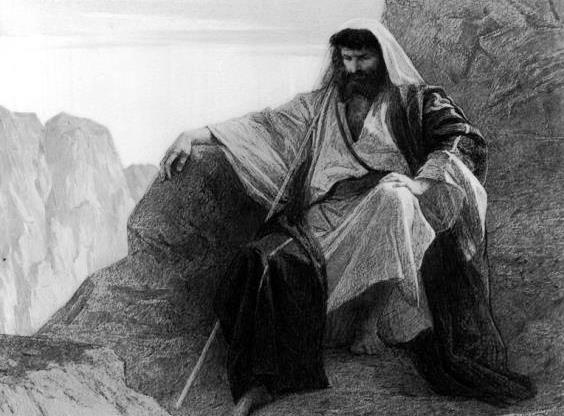
From the Torah’s description, it is clear that the primary occupation of Jacob and his family was shepherding flocks of sheep and goats. This choice of profession took on a special importance years later, when Joseph needed to present his brothers to Pharaoh. The question that most interested the Egyptian king was: “What is your occupation?”
“We are shepherds,” they replied to Pharaoh, "like our fathers before us.” (Gen. 47:3)
Shepherding was certainly not a respected occupation in Egypt. Nonetheless, the Patriarchs, as well as Moses and David, all worked as shepherds. Why did the forefathers and greatest leaders of the Jewish people choose to herd goats and sheep for their livelihood?
Time for Reflection
According to Rav Kook, the advantage of shepherding may be found in the secluded lifestyle of the shepherd. He is cut off from the noisy distractions of society, with ample time for inner reflection. Also, the labor is not intensive. Unlike farming, shepherding does not require one to invest of all of his energies in material matters.
At the same time, the shepherd remains in constant contact with the real world. His thoughts and musings are sound, firmly rooted in reality. He does not live in an ivory tower, immersed in artificial philosophies detached from life. For this reason, our forefathers, the great thinkers of their time, chose to work as shepherds.
This explanation, however, requires further examination. Especially for Rav Kook, who emphasized the importance of the individual’s connection and contribution to society, what is the value of seclusion and solitude? Is the desire for solitude a positive trait? How do we balance reclusive behavior with the greater ideals of refining humanity and elevating the universe?
The Radical Path of Great Souls
The third volume of Rav Kook’s magnum opus, Orot HaKodesh, contains a collection of passages on solitude and silence, entitled Prishut (Asceticism or Seclusion). These short essays analyze the purpose of hitbodedut (solitude) and its function within society.
From the start, Rav Kook makes it clear that the path of solitude is not appropriate for all or even most people. The middle path, the "golden mean,” is the lifestyle suitable for the average person. This is a varied and balanced approach that provides for a rich and satisfying life.
But there are exceptional souls for whom the most appropriate approach is one of radical spirituality. These souls need a path that combines asceticism and extraordinary purity. Just like the extreme dedication of a great scientist or artist to his field of expertise, the ascetic life of Prishut enables these unique individuals to pioneer a new spiritual trail for the entire world. With their radical lifestyle, they are able to realize tremendous personal satisfaction and happiness — much more in fact than the ordinary level of contentment experienced by ‘normal’ people with their well-balanced lives.
Why do they need such a radical path? The greater the soul, the more it must struggle in order to find itself. The depths of the human soul are hidden from the conscious mind. Only through extended solitude and hitbodedut can one examine ideas, deepen thoughts, and expand the mind. Only then will the soul truly reveal itself, unveiling some of the splendor of its brilliant inner light.
The constant company of unrefined people dims the clarity of higher aspirations and constricts one’s important spiritual work. Even excessive contact with friends and associates violates the sublime heights of seclusion and limits the creative fountain of elevated life, so pure and joyous, so holy and noble.
The Language of Inspiration
Hitbodedut also has its own language: the sublime language of silence.
Silence is not just the absence of speech. Silence comes from an outpouring of the soul, and is a vehicle of ruach hakodesh (Divine inspiration). What makes silence the “language of wisdom”?
The wellsprings of the soul require great expanses. Silence is a very inner hitbodedut, free of external limitations. While speech is a constructive power, it nonetheless disrupts the soul’s creative forces. Speech is based on the old, the known and the finite. It thus restricts the inspired flow of thoughts exploring the new and original.
The depths of the soul demand silence. The soul requires quiet for all the elevated thoughts that cannot be limited within the confines of human language. When masters of silent thought are immersed in their elevated silence, they create many worlds, and elevate sublime songs to the heights of their holiness.
Silence is full of life, revealing treasures from the beauty of wisdom. This is the highest silence, a silence that rises in its beauty beyond the powerful wind, beyond the earthquake, beyond the fire. "A still, silent voice... and behold! God passes!” (I Kings 19:11-13).
Hidden Connection
But what about the connection of these special individuals to the world? We should be aware of how their seclusion benefits society. Even when they are isolated, their spiritual connection to society is never broken. They are always contemplating their generation, praying for their sake, and envisioning their elevation.
In general, we may speak of two paths: separation and connection. Separation is the withdrawal of the individual within himself. It is the result of aspirations to attain inner perfection in the spiritual, emotional, and intellectual spheres.
But the goal is not merely personal self-fulfillment. In the depths of this withdrawal lies a hidden connection to society. At the same time that these special individuals separate themselves from the masses, they are guarding over their lofty aspirations — aspirations far beyond ordinary values. They specialize in developing talents and ideas that, as they spread throughout society, serve as a source of blessing for all. As they establish their unique traits and paths, life itself is advanced and acquires purpose.
Thus, the path of holiness is not separation for its own sake, but separation in order to connect and influence. This approach is the exact opposite of simplistic inclusiveness, which attempts to bind and contain everything into one uniform package, thus losing all beauty and nobility in dull uniformity. In the end, the repressive, totalitarian approach leads to disunity, as all parts yearn to separate in order to express their unique nature. The Zohar summaries these two opposite approaches with the following concise formulation:
The side of unholiness begins with chibur (connection) and ends with pirud (division); while the side of holiness begins with pirud and ends with chibur.
What do the practitioners of hitbodedut experience? In what appears to be an autobiographical passage, Rav Kook describes the experience of the secluded individual and his hidden connection to the world:
There are times when one feels that his entire spirit has withdrawn within itself. One becomes centered in his essential self, impervious to the external world. This state is to be bound in the depths of inner hitbodedut.
If another were to visit him in this state, the visitor would not know what was happening in his spirit. He may judge him harshly, for being anti-social, distant from people, and estranged from everything — life, the world. But in the truth of his spirit, he senses a wonderful, unified harmony. Inside himself, it is very good for him. He now experiences the exquisite quietude sought by all. He truly sits at the top of the world. Despite his isolation, we should recognize that, imperceptibly, his intense focus of inner life has a greater impact on his surroundings than the most energetic and clamorous initiatives. (Orot HaKodesh vol. III p. 269)
(Adapted from Ein Eyah vol. IV, pp. 144-145; Orot HaKodesh vol. III, pp. 267, 269-274; vol. II, pp. 439-441)