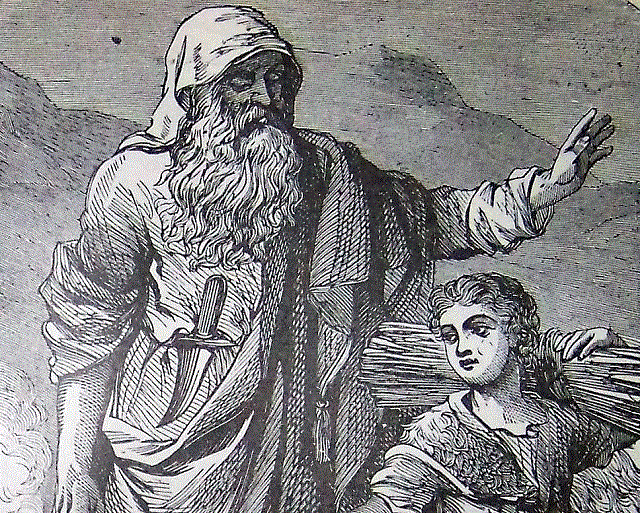
On the third day, Abraham lifted his eyes and saw the place from afar. (Gen. 22:4)
For three days Abraham traveled, following God’s command, towards Mount Moriah. What happened during this long journey, the prelude to the Akeidah? What was Abraham — a loving father, soon to offer up his only son to God — thinking about? What were his feelings and emotions?
In general, the Torah’s style is terse. The text focuses on actions, rarely describing inner thoughts and emotions. Still, a careful reading reveals much about how Abraham undertook this trial.
The Greatest Challenge of the Akeidah
God did not initially tell Abraham where to offer his son. The Divine command was deliberately vague. “Bring him there for an offering, on one of the mountains that I will tell you” (Gen. 22:2). Rav Kook wrote that this detail indicates the most challenging and remarkable aspect of the test.
It would not be sufficient for Abraham merely to carry out the technical aspects of the Akeidah. If Abraham had gone through the outward motions — preparing the wood and the knife, bringing the fire and his son — and yet was inwardly troubled by fears and doubts — he would have failed the test.
Abraham needed to be ready to receive an additional prophecy. Only after three days would the exact location of the Akeidah be revealed to him.
And that was the catch. Only a person who is at peace with himself, filled with joy and happiness, is a fitting vessel for prophecy. To complete the test, Abraham would require incredible reserves of spiritual fortitude to be able to receive that future prophecy. If Abraham was disturbed by misgivings and doubts, if his faith and equilibrium were shaken, he would not merit receiving God’s instructions where to offer up Isaac. Without rock-solid faith in his mission, Abraham would never make it to Mount Moriah.
Focused Yet Serene
In fact, the text hints at Abraham’s remarkable strength and composure as he readied himself to fulfill God’s command.
“Abraham woke up early in the morning.” Abraham had been called to sacrifice his beloved son — how could he sleep? A man of lesser faith would have been unable to sleep, disturbed and troubled over what was expected of him. But no feelings of anxiety disturbed the sleep of this remarkable tzaddik. He awoke at his usual hour, eager to perform God’s will with the swiftness of a deer and the courage of a lion.
“He saddled his donkey.” Abraham’s every move was deliberate and precise. His first priority was to arrange the fastest and most assured transportation to fulfill his mission. Only afterward did he attend to other, less essential preparations for the journey.
“He split wood for the offering.” Abraham could have waited until later to find wood. Or he could have brought the wood, and only later split it into smaller pieces. But a profound love of God, beyond ordinary human measure, burned so fiercely in his heart that he made sure to prepare every detail.
“And he rose” — not bowed and beaten, but proud and tall, full of strength and energy — "and went to the place that God had told him.” All of Abraham’s actions were focused on reaching the desired destination and fulfilling God’s word. Everything else, whether of a personal or societal nature, became inconsequential compared to his soul’s burning desire to carry out the Divine command.
“On the third day....” What happened during those three days? The text does not tell us. The unique experiences of that spiritual journey cannot be expressed in words; they transcend the limits of human language.
“Abraham lifted his eyes and saw the place from afar.” What was to be an oral prophecy — “on one of the mountains that I will tell you” — was in fact a prophetic vision. Abraham’s soul experienced a spiritual elevation so great that his senses became united. Speech and sight, together with his faculties of prophetic insight, were combined as one. “Abraham lifted his eyes.” His physical eyes became receptors for prophetic vision.
Abraham had passed the most extraordinary aspect of the trial. He had reached Mount Moriah, where the Akeidah would take place.
(Adapted from Olat Re’iyah vol. I, pp. 86-87)