The following description of Purim in Rav Kook’s house when he served as chief rabbi of Jaffa was related by Rabbi Yeshaya Greenberg, headmaster of the Sha’arei Torah school in Jaffa:
The joy overflowed in the Rav’s house during the Purim holiday. Breslov hassidim, who throughout the year were warmly received by Rav Kook, on Purim became the head merry-makers. Reb Meir Anshin and his friends would dance on the table, and the sounds of song and laughter drew many people to the Rav’s house.
Between songs and dances, Rav Kook spoke about the holiday, making frequent interruptions to drink a lechaim. Any question or comment received an immediate rejoinder, with the Rav finding a direct connection to the holiday.
Reb Moshe’s Question
At one point, Reb Moshe Betzalel Todrosovich, a wealthy Jaffa merchant and philanthropist who was instrumental in bringing Rav Kook to Jaffa, entered the Rav’s house. Reb Moshe had already finished his Purim meal at home, and being somewhat inebriated, requested that the Rav expound upon a verse that had no obvious connection to the holiday.
“Rebbe, please explain to us the verse, ‘And Lotan’s sister was Timna’ (Gen. 36:22).”
Rav Kook looked up and fixed his gaze on the questioner. “Why, Reb Moshe, that verse is integrally connected to Purim,“ he replied with a wide smile. “In fact, the whole story of Purim begins from there!”
Reb Moshe was astounded. “Really? What does Lotan’s sister have to do with Purim?”
The Reason for Amalek’s Hatred
Rav Kook then quoted the Talmudic statement in Sanhedrin 99b that Timna wanted to marry into the family of Abraham but was not accepted. In the end, she became the concubine of Esau’s eldest son. “Better to be a maidservant to this people,” Timna reasoned, “than a princess of another people.”
As punishment for rejecting Timna, the Jewish people were cursed with the eternal enmity of Timna’s son — Amalek.
This of course is the connection to the story of Purim, for Haman, the enemy of the Jews, was a descendant of Amalek. Haman’s hatred of the Jews and his decree to destroy them in fact originated in the failure to convert his great-grandmother Timna. But this error was redressed in the time of Mordechai and Esther, when “Many of the peoples of the land became Jews” (Esther 8:17).
Rav Kook continued to expound on this topic for two hours, drawing from both Halachic and Aggadic sources, quoting the Zohar and Maimonides, his words shining with brilliance and erudition. When he finally concluded, Reb Moshe jumped up, grabbed the Rav and hugged him, crying, “Rebbe, I love you!”
(Silver from the Land of Israel, pp, 143-144. Adapted from Mo'adei HaRe’iyah , pp. 248-249.)
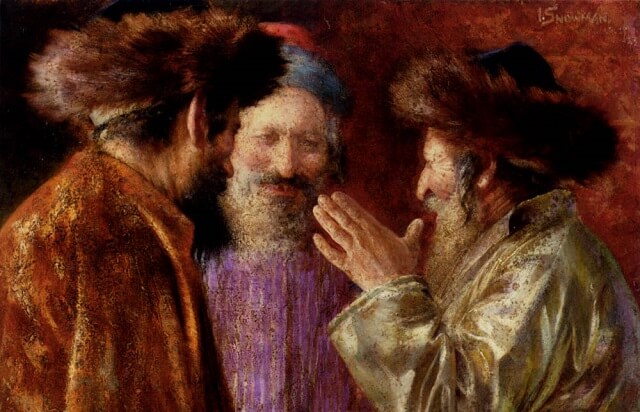
Illustration image: ‘Three Rabbis of Jerusalem’ (Isaac Snowman, 1873-1947)