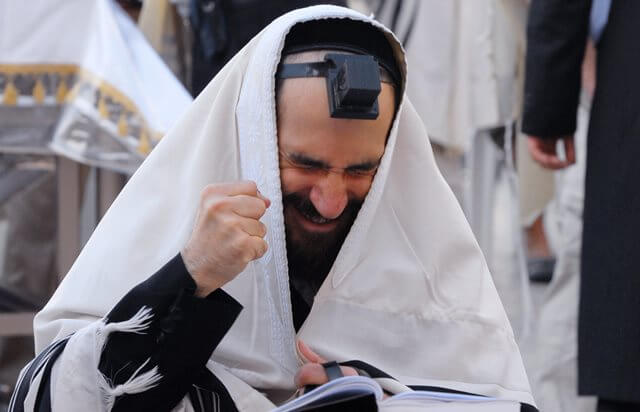
Before praying, we need to clear and direct our thoughts. But we should also prepare our hearts. Which emotions are conducive to prayer?
Avoid Sorrow and Idleness
The Sages taught that two specific emotions should be avoided: “One should not rise to pray while sunk in sorrow or idleness” (Berakhot 31a). Why are these emotions obstructive to prayer?
We function in three realms — in our thoughts, emotions, and actions — and we aspire to serve God in all three. In the realm of thought, we serve God through Torah study. In the realm of deed, through practical mitzvot. Between these intellectual and physical services, lies the intermediate realm of prayer: the service of the heart. Prayer engages our emotions; and through our emotions, it bolsters the other two realms. It inspires us to contemplate holy thoughts, and it motivates us to perform mitzvot and acts of kindness.
But we must be ready to receive the positive influence of prayer. Therefore the Sages counseled that we should avoid sorrow and idleness. People who are depressed will be discouraged from exerting themselves to seek pure and enlightened thoughts. And idleness is a lethargic state when people are disinclined from engaging in good deeds.
If we can steer away from sorrow and idleness, we will be more receptive to the benefits of prayer.
Four Preparations
The Sages also mentioned four activities that are inappropriate before prayer because of the emotional state that they induce. They are: laughter, conversation, frivolity, and idle chatter.
To merit heartfelt prayer, we should prepare ourselves in four ways.
First, we need to acquire an overall attitude of seriousness and reverence. This is the opposite of joking and flippant laughter. Those who constantly jest belittle their sense of reverence. For such people, nothing is serious. Nothing needs to be respected, even their own inner self and higher aspirations.
The second preparation for prayer is to internalize the truth that the soul’s true perfection is only found in its inner happiness. We must recognize the unique honor and joy when the soul is enlightened with the light of knowledge and awe of God. Since the soul attains true happiness when it meditates inwards, as we prepare to pray we should avoid any activity that indicates that the source of our happiness may be found outside of ourselves. This is the essence of conversation: that we seek what we lack, not within ourselves, but in others.
The third preparation is to avoid frivolity — literally, kalut-rosh or lightheadedness. It is important that we conduct ourselves according to our highest visualization of Divine service. There should not be a disconnect between our ideals and our behavior. Thus we must avoid kalut-rosh, which indicates an attitude of disregarding our cognitive inner truths, a willingness to act in contradiction to our beliefs. This negates the very purpose of prayer, which works to create harmony between the three realms of mind, heart, and body.
The final preparation for prayer is to internalize the importance of speech. Only if we are able to fully appreciate our faculty of speech — a unique gift to humanity — can we properly value the act of prayer. We should avoid idle chatter, especially before prayer, as such talk belittles the value of speech. Rather, we should respect and safeguard this gift.
To summarize the four principles of true prayer:
- Taking ourselves and our higher aspirations seriously;
- What we truly seek is within, not without;
- Harmony between belief and deed;
- Appreciating the power of speech.
Mitzvah Joy
Avoiding sorrow and idleness, refraining from laughter, conversation, frivolity, and idle chatter — these are all negative guidelines. Is there also a positive preparation for prayer?
The Sages mentioned one emotion as a positive preparation: "the joy of performing a mitzvah.” While a mitzvah is a physical act, typically performed for others, the joy we feel in its performance is an internal emotion. It is a wonderful feeling of pride and accomplishment, as the soul rejoices in the correctness of its path. This feeling of completeness, the harmonious balance between our external and internal worlds, is uniquely suitable to ready ourselves for prayer.
(Adapted from introduction to Olat Re’iyah vol. I, p. 29)