Rabban Gamliel, the son of Rabbi Yehuda HaNasi, would say:
“Torah study unaccompanied by labor (melacha) comes to nothing and leads to sin.” (Avot 2:2)
On its surface, this echoes Rabban Gamliel’s previous statement: “Torah study is beautiful when combined with worldly occupation (derech eretz).”
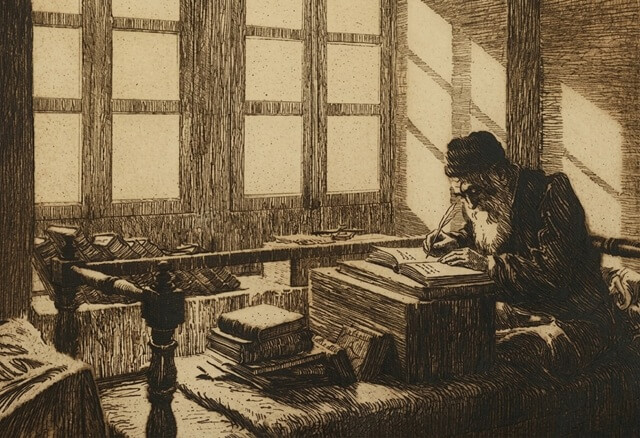
Yet it may also bear a deeper meaning, one especially important in an age of spiritual decline: Torah study must be accompanied by creative labor. Melacha may be understood here not as practical labor, but specifically as artistic craftsmanship: the skilled expression of Torah in literary works.
If the wisdom of Torah is to reach out and uplift, it must find expression in literature. Literature is a powerful tool to illuminate and inspire. This calls for scholars to cultivate their own inner spiritual awareness, and to immerse themselves in the inner realms of Torah — in the study of Aggadah and Kabbalah, Jewish thought and faith — in all their breadth and richness.
Alongside these literary endeavors, we are called to produce another form of creative work: to revive the practical realm of Torah by introducing clarity and structure into the domain of Jewish law. In this, we follow the example of the sages of the Mishnah and the Talmud, who combined Torah wisdom with literary craftsmanship. They transformed Torah law into an enduring literary form, as they organized and recorded the Torah’s oral traditions.[1]
From that time forward, literary expression and Torah scholarship have walked hand in hand.
Rabban Gamliel’s teaching thus returns to us with renewed force. Torah study is not meant to remain private or passive. We are summoned to create and to author, to labor in writing and communicating Torah.
“Torah study unaccompanied by labor comes to nothing.” The labor demanded of us is the labor of creation: to give voice to Torah, so that its light may spread and uplift the life of the nation.
(Adapted from “Rav Kook’s Lecture,” printed at the end of Orot HaTorah).
It was Rabban Gamliel’s father, Rabbi Yehuda HaNasi, who undertook the monumental task of compiling the Mishnah, giving the Oral Law enduring written form so that it would not be lost during the long centuries of dispersion and exile. ↩︎