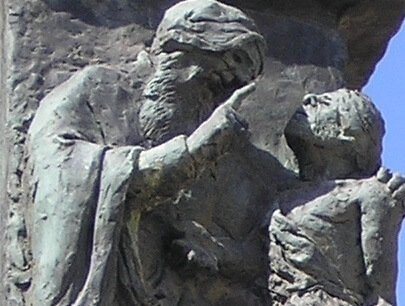
In the second chapter of Pirkei Avot (“Ethics of the Fathers”), we read five sayings of Hillel the Elder.
Hillel would say:
- Do not separate yourself from the community.
- Do not place absolute trust in yourself until the day you die.
- Do not pass judgment on your fellow until you have stood in his place.
- Do not say something that is not readily understood, hoping that eventually it will be understood.
- Do not say: ‘When I have free time, I will study’; perhaps you will never have the time.
The overall message of Hillel’s warnings is: Be careful! Do not place too much trust in the goodness of anyone, including yourself. No one is perfect, not even the greatest prophet or religious leader.
To illustrate the danger of excessive confidence in one’s own righteousness, the Talmud cites the example of Yochanan the High Priest, who, after eighty years of devoted service in the Temple, ultimately strayed into heresy.
Our tendency toward self-complacency often arises from the inevitable comparisons we make between others and ourselves. Hillel emphasizes the need for circumspection in this regard. Are we truly aware of the pressures and challenges that others face? Can we ever truly know how we would act in their circumstances?
In a similar vein, Hillel cautioned against assuming that vague or ambiguous statements will be properly understood in the end. And finally, he warned against leaving Torah study to chance. We must consciously set aside time for study and spiritual growth.
The Importance of Community
Yet Hillel’s opening statement — “Do not separate yourself from the community” — seems unrelated. What does communal belonging have to do with his other warnings? Why is it so important to be part of the community?
Rav Kook explains that individuals are inherently unstable. A person may rise or fall, grow or regress. Thus we should maintain a measure of skepticism toward individual virtue and motivations — even our own.
The community, however, is different. The nation is a community of faith, rooted in Knesset Yisrael, the collective soul and spiritual identity of the Jewish people. While individuals fluctuate, this inner essence remains constant.
That is why we must stay anchored to it, connected to this enduring source of truth and goodness. We should be circumspect about ourselves and others; but the community as a whole, Hillel taught, can always be trusted.
Cleaving to the Soul of the Jewish People
This idea stands in contrast to the Hasidic model of cleaving to a tzaddik, a central righteous leader whose life serves as a guide for his followers.
Cleaving to a tzaddik — so that the vital force of being of the tzaddik’s soul will intermingle one's own imperfect soul — this is a very respectable aspect in the process of spiritual growth. However, it requires great caution. If one should err with regard to the tzaddik and cling to his inner essence, he will also be adhering to his faults. And these deficiencies may at times be more detrimental to the follower than to the original person [the tzaddik].
Fortunate are Israel, who cleave to the soul of the nation, which is absolute good. Through it, they are able to draw from God’s good light [in their own soul].
(Adapted from Olat Re’iyah vol. II, p. 164; Orot Yisrael 3:3, p. 146)
Illustration image: ‘Hillel’s Teachings, bronze relief from the Knesset Menorah’ (wikimedia.org)