Rabbi Akiva taught: “All is foreseen, yet freedom of choice is granted” (Avot 3:15).
In this terse statement, Rabbi Akiva brings together two central tenets of Judaism: God’s complete foreknowledge of all things, including human actions, and the human capacity for free choice.
At first glance, these principles appear to contradict one another. If God already knows what I will do, how can my choices truly be free? Yet without free will, moral responsibility collapses. If I have no genuine choice, how can I be held accountable for my actions?[1]
The Hidden Reservoir of Free Will
In a letter from 1910, Rav Kook offers an original approach to understanding Rabbi Akiva’s statement. Rabbi Akiva is not juxtaposing two conflicting ideas; rather, he is describing two complementary dimensions of freedom.
Why do we place such supreme value on free will? Why is it so essential that we be free agents?
It is not only because accountability requires that we have choice. That is a consideration for society. Free will matters deeply because only actions taken without coercion express the very essence of the self. Freedom is what allows us to be authentic and true to ourselves. We are not automatons; we are not creatures driven blindly by biological wants and needs. We are autonomous human beings, able to make moral choices and decide our path in life.
Yet, if we take an honest look at life, we see how limited our freedom really is. Every choice we make is constrained by forces beyond our control: innate ability, upbringing, social pressures, material conditions, ingrained habits, and the accumulated weight of past decisions.
What we commonly call free will is, in fact, a narrow band of autonomy within a dense web of influences. Rav Kook suggests that beyond this lies a far deeper reservoir of freedom. If the Creator intends to bestow the highest good upon humanity, then human freedom must ultimately be far more expansive than what we consciously experience. This hidden freedom nurtures the unfolding of our inner essence. The freedom of choice that we experience is only the tip of the iceberg, a small expression of the full expanse of humanity’s free will.
Enabling Free Agency
From the Divine perspective, which transcends time, God’s foreknowledge encompasses this greater freedom in its fullness. “All is foreseen.” Through it, human life is guided toward growth and fulfillment. Only a small portion of this freedom appears to us as the ability to choose between right and wrong. Its root, however, lies in a higher stratum of freedom that directs life toward its ultimate good.
This may be compared to a child. We do not give children full autonomy. This is not because we deny them freedom, but because it must grow over time. Boundaries serve to protect the child, allowing his or her abilities to develop safely, until the child matures and is ready for greater freedom.
So too, higher influences, such as ancestral merit (zekhut avot), serve to counterbalance the powerful pull of instinct and social conditioning. They enable a person’s choices to align more closely with one’s true aspirations and inner self.
When Rabbi Akiva said “All is foreseen,” he referred to this hidden reservoir of freedom: the deeper level that knows the inner essence of a person and sets the boundaries within which revealed free will is able to operate. Divine foreknowledge does not negate human freedom. Just the opposite: it makes authentic freedom possible, freeing us from subjugation to impulse and circumstance.
“All is foreseen” — and therefore — “freedom of choice is granted.”
(Adapted from Iggerot HaRe’iyah I, letter 283).
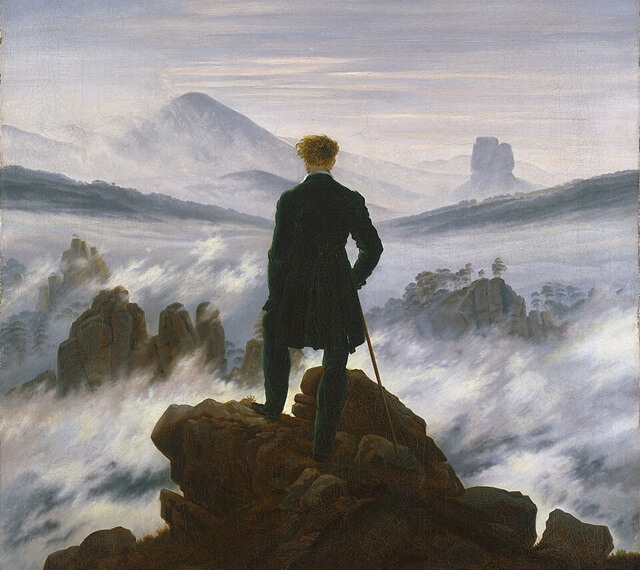
Image: "Wanderer above the Sea of Fog" by Caspar David Friedrich, 1818
Philosophers have long grappled with the paradox of foreknowledge and free will. Maimonides explains that “knowledge,” when applied to God, is not used in the same sense as human knowledge; since God transcends time, His knowledge is not temporally prior and therefore does not cause or necessitate human action (Guide for the Perplexed III:20; cf. Mishneh Torah, Hilkhot Teshuvah 5:5). ↩︎