An Assembly in Jerusalem
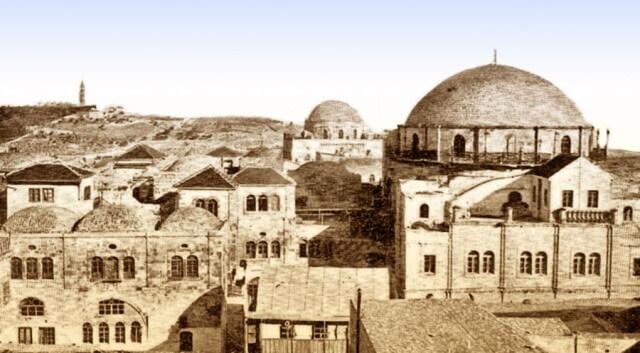
In the summer of 1923, the Jewish community held a festive service in the Rabbi Yehudah Hasid synagogue in Jerusalem’s Old City. The country was then under the rule of the British Mandate, and community leaders organized an assembly of prayers and thanks to the British government in honor of King George V’s birthday.
The general atmosphere in the country was, however, one of disappointment and even bitterness. The 1917 Balfour Declaration and the 1920 San Remo Conference had promised to establish a Jewish national home in Palestine, but the policy of the British Mandate in practice was a different story. In an attempt to appease the Arabs, the British White Paper of 1922 placed severe limits on Jewish immigration. Britain furthermore split Mandatory Palestine into two, excluding all lands east of the Jordan River from Jewish settlement.
Rav Kook was one of the speakers at the 1923 assembly. In order to raise the spirits of the Jews of Eretz Yisrael — and also remind the British government of its promises to the Jewish people — he quoted from the week’s Haftarah reading. He spoke about the prophecy of Zechariah, who lived at the time of a previous return to Zion, when the Jewish people returned from the Babylonian exile 2,500 years earlier.
Zechariah’s Words of Encouragement
There are many parallels between that era and our own time. The Jews returning from Babylonia were disillusioned and downhearted, and the foreign peoples whom the Babylonians had settled in the land created many difficulties. Zechariah sought to reassure the discouraged Jewish settlers.
“Who are you, great mountain? Before Zerubavel, you will be a flat plain!” (Zechariah 4:7)
To what ‘great mountain’ was the prophet speaking?
The path leading toward the fulfillment of God’s promise to His people, the return to Zion, was endorsed by the mighty empire of those days — Persia. Cyrus, the king of Persia, had officially appointed Zerubavel to oversee the rebuilding of the Jewish community in the land of Israel. Zerubavel, a direct descendant of King Jehoiachin, the penultimate king of Judah, led the first band of Jews back to Jerusalem.
There were, however, many obstacles on the way. The prophet poetically refers to these hurdles as ‘great mountains,’ blocking the path and obstructing the return to Zion. Yet, before the king’s representative, Zerubavel, these difficulties are nothing; he will flatten them like a level plain.
The Mission of the King’s Representative
We live in similar times, Rav Kook concluded. God is fulfilling His promise to restore the Jewish people to their land — this time, through the mighty empire of Great Britain. It is our expectation that, in accordance with the declaration of His Majesty’s government, the king’s representative — the British High Commissioner — will expedite the return of Israel to the Holy Land, despite the difficulties obstructing this historic process.
“Who are you, great mountain?” Regardless of the complexity of the problems, despite the desire of other peoples to hinder and obstruct, before the power of the tool of Divine Providence, all of these obstacles will be smoothed over and the path to redemption will be like ‘a level plain.’
(Silver from the Land of Israel, pp. 185-187. Adapted from Mo'adei HaRe’iyah, p. 403)