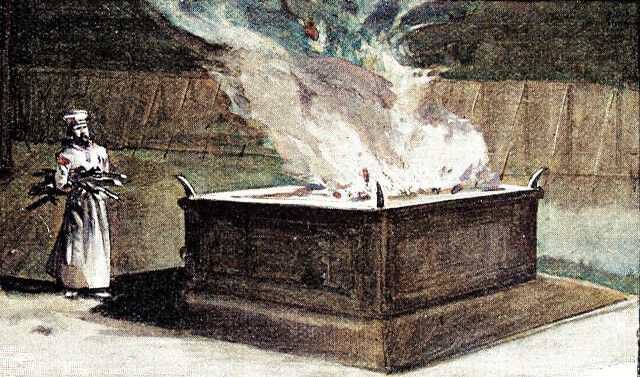
Sacrifices are not an innovation of the Jewish people. Noah also offered sacrifices to God. However, not all offerings are equal. The Midrash employs the following parable to illustrate this idea:
There was once a king who hired two chefs. The first chef cooked a meal that the king ate and enjoyed. Then the second chef cooked a meal that the king ate and enjoyed. How can we know which meal the king enjoyed more? When the king subsequently commanded the second chef, Make for me again the dish that you prepared, we realize that the second meal was the king’s preferred dish.
In other words, by the fact that God commanded the Jewish people to offer sacrifices, we know that God prefers their offerings to those which Noah initiated on his own accord.
But how do we evaluate the relative worth of different sacrifices? What distinguishes the service of Israel from that of Noah?
Two Goals of Offerings
The key to assessing an offering is to examine its purpose. The more elevated the goal, the more acceptable the offering. Noah’s objective in offering sacrifices after the Flood was very different than that of the Jewish people. Noah sought to preserve the physical world, to protect it from Divine retribution. Noah’s offerings achieved their goal — “God smelled the appeasing fragrance and said to Himself, ‘Never again will I curse the soil because of man'” (Gen. 8:21).
The offerings of the Jewish people aspire to a far greater objective. Their goal is to enable Israel to merit heightened levels of Divine providence and prophecy. The Torah explicitly sets out the purpose of the Temple service: “Make for Me a sanctuary, and I will dwell in their midst” (Ex. 8:25).
Fragrance and Bread
The difference between Noah’s offerings and those of Israel is reflected in the metaphors that the Torah uses to describe them. Noah’s offerings had an “appeasing fragrance” (rei'ach nichoach), while those of Israel are referred as “My bread” (lachmi). What is the difference between a fragrance and food?
When an animal consumes vegetation, the plant life is absorbed into the animal and becomes part of it. In this way, the plant has attained a higher state of being. When a human consumes an animal, the animal is similarly elevated as it becomes part of that human being. This transformation to a higher state through consumption parallels bringing an offering with the objective of attaining a higher state of existence. The offerings of the Jewish people are called “My bread,” since the magnitude of change to which they aspire — perfection as prophetic beings — is similar to the transformations of plant to animal and animal to human.
The offerings of Noah, on the other hand, had only an “appeasing fragrance.” They produced a wonderful scent and appealed to the natural senses, but they did not attempt to effect a fundamental change in nature. Their purpose was to maintain the world, to refine humanity within the framework of its natural moral and intellectual capabilities.
In fact, the offerings of the Jewish people encompass both of these objectives. They are described both as “appeasing fragrance” and as “My bread,” since we aspire to perfection in two areas — natural wisdom and Divine prophecy.
(Sapphire from the Land of Israel. Adapted from Midbar Shur, pp. 155-158)