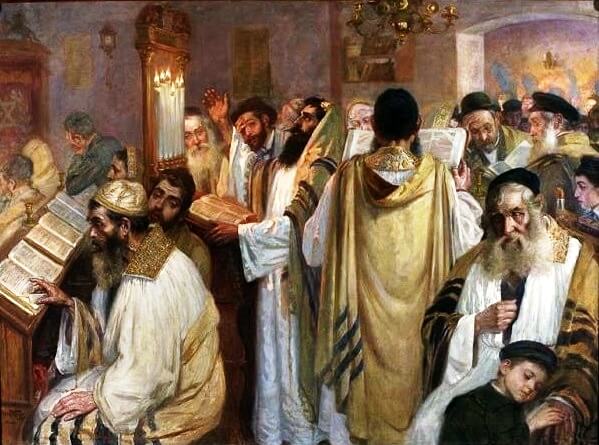
The 82nd chapter of Psalms, which demands a just and righteous society, opens by noting the holiness of the congregation:
God stands in the congregation of the Almighty. (Psalms 82:1)
According to the Talmud, this holds true not only for the entire people of Israel, but for every gathering of worship: "From here we learn that the Holy One is to be found in the synagogue" (Berakhot 6a).
The essence of prayer is a private matter, as the soul turns inwards. Why did the Sages place such importance on public prayer? Why did they emphasize the synagogue as a holy place where God’s presence may be found?
The Constancy of the Collective
The strength of the collective lies in its stability. Once the community has been set on the correct path, it will not veer from it. Individuals, on the other hand, are unpredictable. People undergoing changes of heart and direction. But the community will always remain faithful to its ideals, as it says, "My spirit that is on you... will not leave your mouth or the mouth of your descendants... from now and to eternity” (Isaiah 59:21).
This quality of steadfastness is a Divine attribute. "I, God, have not changed” (Malachi 3:6). The aspect of immutability, of remaining faithful to the good, is the Divine quality of the synagogue, as a designated place where the congregation assembles for holy goals.
Interestingly, the scholar who emphasized this aspect of the community was Hillel. He would admonish:
Do not separate yourself from the community. Do not trust in yourself until the day of your death. (Avot 2:5)
Hillel’s two warnings share a common insight into human nature. Individuals do not always stay in the same state. They can grow and develop, and they can deteriorate. As an extreme example, the Sages recalled the incident of a High Priest who became a heretic after eighty years of devoted service in the holy Temple.
Since we cannot fully rely on ourselves, we should take care not to separate from the community. We need to be part of the community in order to offset our inherent instability.
For this reason, the Hebrew word for a synagogue is not Beit Tefillah, a house of prayer, but Beit Kenesset, a house of gathering. (The Greek word ’synagogue’ also means ‘place of assembly'). The holiness of a synagogue derives from its function as a gathering place for the community.
Standing Firm
The psalmist used the Hebrew word 'nitzav' in describing the holiness of the community: ‘God stands (nitzav) in the congregation of the Almighty.’ 'Nitzav' portrays a stable, fixed state. The holiness of the congregation is rooted in its steadfast constancy in pursuing its ideals and aspirations.
Similarly, we find the Torah uses 'nitzav' when describing the eternal covenant that God made with the entire Jewish people at the plains of Moab, as they prepared to enter the Land of Israel. The word 'nitzav' indicates their acceptance of this brit for all generations:
Today, you are all standing (nitzavim) before God... to bring you into God’s covenant.... In order to establish you on this day as His nation, and He will be your God. (Deut. 29:9-12)
(Adapted from Ein Eyah vol. I, pp. 22-23)