Perhaps the lowest point in the history of the Jewish people occurred shortly after the Torah’s revelation at Mount Sinai. Without Moses’ leadership and guidance, the people turned to idolatry, worshipping a golden calf.
Divine justice demanded that this terrible betrayal be punished severely, but Moses “pleaded before God” on their behalf (Exod. 32:11).
The word for “pleaded” — וַיְחַל — is not the usual expression for prayer. The Sages offered several explanations why the Torah used this particular word to describe Moses’ prayer. Rabbi Elazar noted that וַיְחַל (va-yechal) shares the same root as חולה (choleh), meaning “sick.” Moses prayed for the sake of Israel so intensely that he became ill from the effort.
According to Rabbi Eliezer the Great, the word וַיְחַל even indicates the specific illness that afflicted Moses. Moses suffered from achilu, a fever in the bones.
Why should Moses’ efforts for the sake of the Jewish people make him ill? What is the significance of a fever in his bones?
Intensity of Prayer
The gravity of the Sin of the Golden Calf should not be underestimated. It was not a foregone conclusion that God would forgive the Israelites. Divine justice dictated that the Jewish nation deserved to be destroyed for this calamitous breach of faith.
Moses could not offer just any prayer in their defense. Their sin was beyond the normal efforts of the great leader to rectify. In order to recover, to some extent, the spiritual state they had attained at Sinai, Moses needed to pray with an intensity that exceeded his natural powers. The exertion was so great that Moses became ill. This is one implication of the word וַיְחַל — a pleading so intense that it disrupted his body’s normal functioning.
Awakening the Fire in the Bones
Rabbi Eliezer the Great provided an additional insight into Moses’ extraordinary prayer. Although bones are not particularly sensitive, they nevertheless contain a condensed essence of life. (The word etzem in Hebrew means both ‘bone’ and ‘essence.’) When the life-force has left all other parts of the body, it still remains in the bones. A starved individual, just barely alive, will appear to be a walking skeleton.
Thus bones are a metaphor for the marrow of life, stored deep inside the body. This life-force is not normally felt, unless it is awakened by a very powerful force. Ezekiel thus described the national revival of the Jewish people with a vision of dry bones coming back to life.
Moses was unable to plead the case of the Jewish people using only his natural powers. He needed to awaken all of his powers, even those hidden deeply within. His extraordinary effort was in equal measure to the people’s cataclysmic spiritual breakdown. The nation’s descent into idolatry could not be corrected by the regular influence of ethical life alone. It was necessary that powers from the soul’s essence — from the people’s inner goodness and holiness, hidden deeply in their bones — be awakened.
Since these aspects of life are ordinarily hidden, their awakening is an unnatural, even extreme measure. Moses’ plea for the sake of Israel at that critical time was thus based on a special fire — a fire of holiness, smoldering inside their very bones.
(Sapphire from the Land of Israel. Adapted from Ein Eyah vol. I, pp. 144, 146)
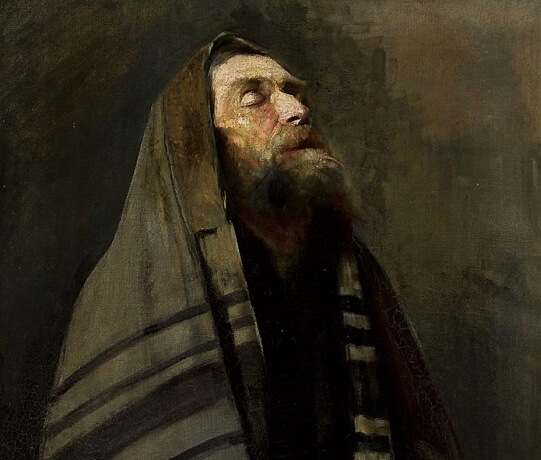
Illustration image: ‘The Praying Jew’ (Aleksander Grodzicki, 1893)