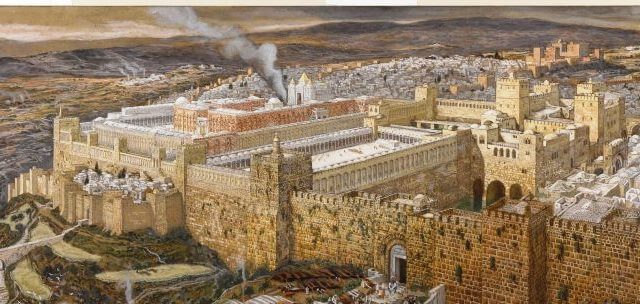
The Israelites, having miraculously escaped death at the hands of the Egyptian army, sang a beautiful song of praise and thanksgiving for their Divine rescue — Shirat HaYam. The song concludes with the national aspiration to be settled in the Land of Israel, experiencing God’s Presence in the Temple on Mount Moriah:
תְּבִאֵמוֹ וְתִטָּעֵמוֹ בְּהַר נַחֲלָתְךָ — מָכוֹן לְשִׁבְתְּךָ פָּעַלְתָּ ה'; מִקְּדָשׁ, אֲדֹנָי כּוֹנְנוּ יָדֶיךָ.
Bring [the people] and plant them on the Mount You possess. To the place of Your dwelling that You prepared, God — the Temple, God, that Your hands have founded. (Ex. 15:17)
The Sages noted that the word Mikdash (Temple) is sandwiched in between God’s Name. “Great is the Temple, since it was placed between two Divine Names” (Berakhot 33a). What is the significance of this fact?
In general, we need to examine how it is possible that a unique level of sanctity may be restricted to a particular location. What relationship can there be between holiness — a boundless, non-physical quality — and the boundaries of physical space? How can God’s Presence be confined to a specific structure?
Spatial Sanctity
In truth, we cannot fathom the mystery of holiness limited to a particular place. However, we can recognize the logical benefit in designating a location as a focal point for people to gather together with the sacred aim of honoring God. Such a center serves to advance humanity’s moral and spiritual progress.
Of course, the Creator of the human soul knows its inner workings. God knows that designating sanctity to a particular place is necessary for our spiritual growth.
This perhaps explains the significance of two Names of God surrounding the word Mikdash. God’s Name indicates the way we call out to God and how we relate to Him. Our relationship to God, within the context of the Temple, has two aspects. The first is due to the intrinsic sanctity of the Temple, the pinnacle of holiness in the universe. We connect with this inner holiness on a deep emotional level. It inspires our imagination to spiritual greatness, instilling powerful yearnings for goodness and holiness. This is the first Divine Name associated with the Temple.
The second aspect of the Temple stems from its collective benefit for us as social beings. The Temple served as a central location for people to gather together for common spiritual goals, bolstering the moral resolve and aspirations of the entire nation. This aspect of the Temple’s spiritual influence — one that is accessible to human logic — corresponds to the second Divine Name.
In fact, the text hints to both of these aspects. Regarding the intrinsic holiness of the Temple, it says, “The place of Your dwelling that You prepared.” God Himself prepared the Temple’s unfathomable sanctity, inspiring and uplifting those entering its gates.
Regarding the Temple’s function as a spiritual center for the nation, the verse continues, “The Temple, that Your hands have founded.” This is an indirect process, through “God’s hands” — the consequential benefit of the Temple as a center for our collective aspirations, a focal point to advance humanity’s true fulfillment.
(Adapted from Olat Re’iyah vol. I, p. 236; Ein Eyah vol. I, p. 157)
Illustration image: ‘Reconstruction of the Temple of Herod Southeast Corner’ (James Tissot, between 1886-1894)